AI Agent Governance for Enterprises
Gain full visibility into every AI agent interaction. Detect threats like indirect prompt injection and data exfiltration in real time, enforce governance policies, and stay compliant.












%201.avif)

.avif)
Why AI Agent Governance Matters to Enterprises
Ungoverned Agents Create Blind Spots
AI agents connect to internal tools, APIs, and data sources across teams. Full governance is the foundation for identifying unauthorized actions, intent misalignment, and shadow agent usage before they become security incidents.
Agents Face Targeted Attack Techniques
AI agents are vulnerable to indirect prompt injection, memory poisoning, tool poisoning, data exfiltration, and malicious responses. Governance requires real-time detection of these threats at the intent layer.
Compliance Demands Auditability
Regulatory frameworks like the EU AI Act, NIST AI RMF, and ISO 42001 require organizations to demonstrate control over AI systems. Agent governance provides the audit trail and policy enforcement needed for compliance.
The Lasso AI Security Platform
Built from the ground up in the AI era, Lasso's AI Security Platform empowers enterprises to unlock the full potential of LLMs and AI agents safely, responsibly, and confidently.
Unlock the Full Potential of AI Agents, Trust Your Security to Scale
Tool and MCP Governance
Agents are only as secure as the tools they call. Govern every MCP server, API, and external connection with risk scoring based on permissions and actions. Manage or block high-risk tools across Claude Code and Desktop, Cursor, and Codex.
Intent-Aware Governance
Analyze the intent behind every agent action to identify intent misalignment with the organization's policies, indirect prompt injection, memory poisoning, and other AI threats or attack techniques that keyword-based filters miss.
Intent-Aware Policy Enforcement
Deploy intent-aware policies in minutes to enforce role-based permissions and strict Data Loss Prevention. Lasso applies runtime enforcement to identify intent misalignment with the organization's policies.
Cross-Platform Governance
Apply consistent policies across low code no code agents, homegrown applications, MCP-connected workflows, and custom agent frameworks. Lasso governs every agent the enterprise uses or builds with under 50ms latency and 99.83% threat detection accuracy.
Core Components of AI Agent Governance
Agent Discovery
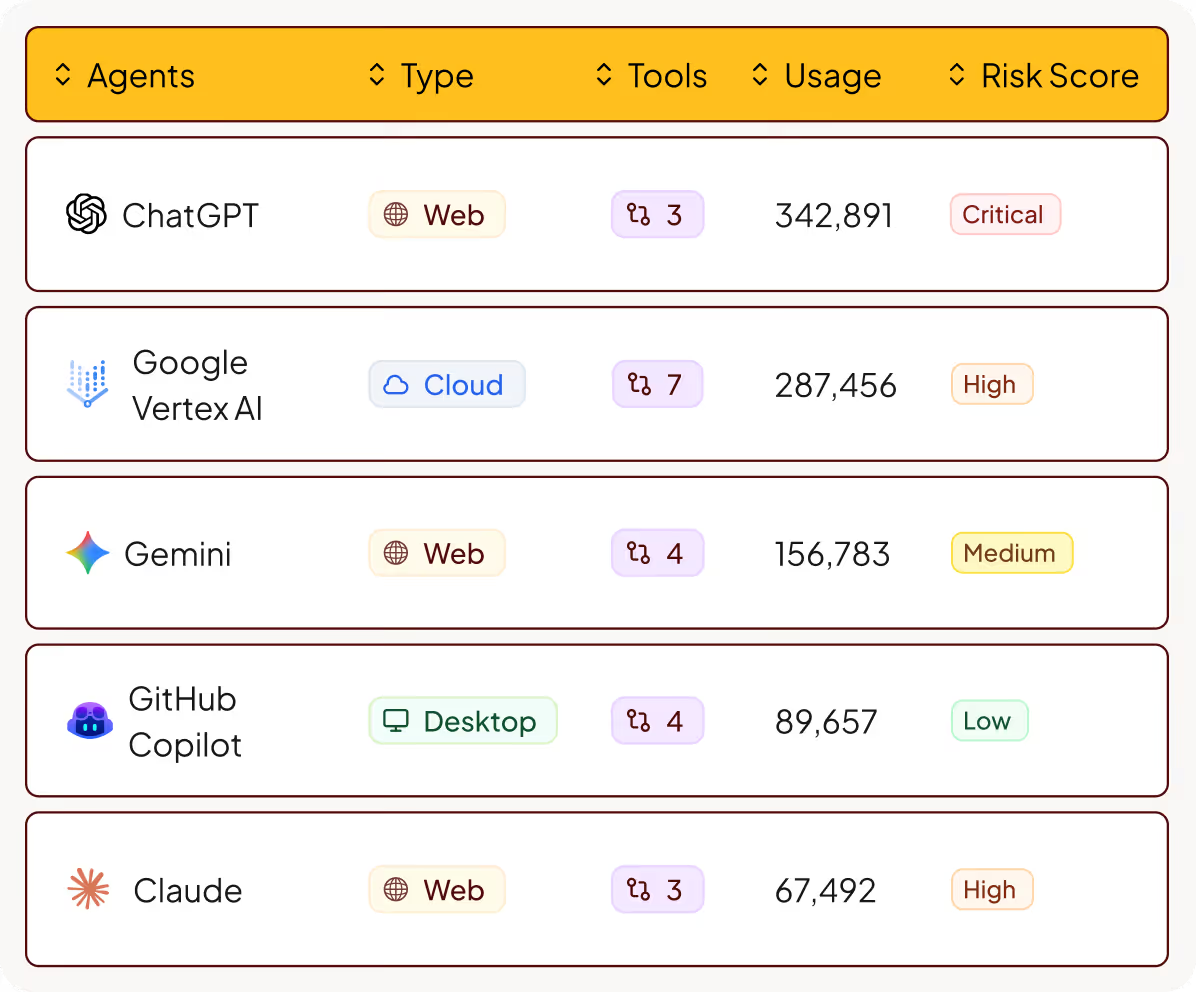
Connect to agent builder platforms, cloud environments, and third-party integrations to automatically discover and inventory every AI agent, profiling each one across its model, system prompt, tools, and guardrails.
Risk Scoring Engine
Assign a dynamic risk score to each agent based on its LLM, connected tools, data access patterns, and behavioral signals. Flag high-risk agents for review and take immediate action.
Real-Time Threat Detection
Identify risks at runtime and anomalous AI behavior with a threat detection accuracy rate of 98.6%, and get immediate alerting with full context on what happened, which application was targeted, what the impact is, and what to do next.
Policy Enforcement Layer
Enforce inline guardrails at the proxy, API, or AI Gateway layer with real-time blocking under 50ms, ensuring agents operate within their intended scope even as environments evolve.
Compliance and Audit Logging
Log every agent interaction with full context for audit readiness and automated reports mapped to NIST AI RMF, EU AI Act, OWASP Top 10, and more.
FAQs
What is AI agent governance?
Why do enterprises need AI agent governance?
What threats do AI agents face?
How does AI agent governance support compliance?
What role does MCP security play in AI agent governance?
What is Lasso's Intent Security and how does it support governance?
Keep up with Lasso
.avif)
OWASP GenAI Security Project Release of Top 10 for Agentic Applications 2026
Lasso Releases First Open Source Security Gateway for MCP